The Ultimate Tool for Organized Learning: Crafting the Perfect School Time Table Journal
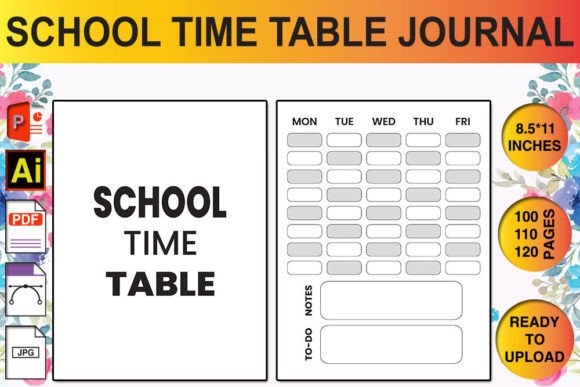
In the bustling environment of education, structure is not merely a convenience; it is a necessity. The rhythm of a school day, the allocation of periods for different subjects, and the tracking of assignments and extracurricular activities form the backbone of effective learning. For educators, administrators, and even parents managing homeschool schedules, a well-designed timetable journal is an indispensable organizational asset. This discussion delves into the practical creation and utilization of such a journal, focusing on a specific, ready-to-use solution: the School Time Table Journal KDP Interior. This product represents not just a printable document, but a comprehensive package designed for those who value both immediate utility and long-term customization.
Understanding the Core Components of a Time Table Journal
A school timetable journal transcends a simple weekly grid. Its interior layout is engineered to support multiple facets of academic life. Typically, it includes dedicated sections for the master weekly schedule, often broken down by day and period. Beyond this, pages for assignment tracking, project deadlines, exam dates, and notes for each subject are common. Some designs incorporate goal-setting areas for the term or semester, as well as space for recording extracurricular commitments and personal reminders. The effectiveness of a journal lies in how seamlessly these components work together to give the user—whether a student, teacher, or principal—a holistic view of their academic commitments.
The physical specifications of such a journal are crucial for professional use. A trim size of 8.5" x 11" is standard, compatible with most binders and folders, and ideal for clear, readable formatting. The decision between having a bleed or no bleed in the design affects the final printed appearance; a no bleed specification, as found in this particular School Time Table Journal KDP Interior, means the content is designed to fit safely within the page margins, simplifying home and office printing without risk of trimmed edges.
From Digital Files to Physical Journals: The Production Workflow
The journey from concept to a tangible, usable journal involves several key stages. It begins with the source files. Having access to multiple file formats unlocks different levels of customization. A PDF file provides a print-ready, fixed layout, ensuring fidelity across all printers. This is the file one would typically upload directly to a print-on-demand service like Amazon KDP. However, for those who wish to adapt the design—to change color schemes, fonts, or add a school logo—source files in PPTX (PowerPoint), AI (Illustrator), and INDD (InDesign) are essential.
Each format serves a distinct user. PowerPoint files offer a relatively accessible platform for basic edits, suitable for educators or parents without advanced design software. Illustrator files cater to graphic designers who want to manipulate vector elements and layouts with precision. InDesign files are the professional standard for complex page layout and typography control, ideal for publishing professionals or school administrative teams producing bulk copies. The inclusion of all these formats in the School Time Table Journal KDP Interior package addresses a wide spectrum of technical expertise, from the hobbyist to the professional designer.
Key Features and Practical Advantages for Diverse Users
The advertised features of a high-quality journal interior directly translate to user benefits. A High Quality Print Ready PDF ensures that the final product, when printed, exhibits sharp text, clear lines, and consistent color. This is vital for readability and professional presentation. The availability of source files for customization is perhaps the most significant advantage. It means the journal is not a static product. A homeschooling parent can personalize it for their child's unique curriculum. A teacher can adapt it to their specific class period structure. A small business owner creating educational planners can rebrand and resell it.
Consider the range of page counts—100, 110, and 120 pages. This variation allows users to select a journal duration that matches their needs. A 100-page journal might suit a single academic term, while a 120-page version could cover a full semester with ample space for detailed notes. This flexibility demonstrates an understanding that different educational contexts have different logistical requirements.
Real-World Applications and Use Cases
The utility of a structured School Time Table Journal extends across several groups. For students, particularly in higher grades, it fosters time management skills, reducing the anxiety of missed deadlines and helping visualize workload balance. Educators can use it to plan their teaching schedule, track student progress across periods, and coordinate with other teachers. School administrators might employ a customized version as a standard planner distributed to all students, promoting organizational consistency across the institution.
Beyond traditional schools, tutors, coaching centers, and online course instructors can utilize these journals to provide their clients with a structured framework for their learning journey. The journal also serves as a valuable tool for educational researchers studying time allocation and learning outcomes, providing a standardized template for data collection. For the KDP entrepreneur or creative hobbyist, this interior package is a ready-made product to sell, or a foundation upon which to build their own branded line of educational planners, significantly reducing initial design time and effort.
Critical Considerations Before Implementation
While the benefits are clear, successful implementation requires some forethought. First, one must assess the compatibility of the source files with their available software. Not every user will have Adobe Illustrator or InDesign; the PowerPoint option provides a crucial alternative. Second, the choice of page count should align with the actual printing intent. For KDP sellers, understanding Amazon's printing specifications for the selected trim size is necessary to ensure the uploaded PDF meets all guidelines.
Another consideration is the audience's preference. Some users prefer minimalist designs with maximum writing space, while others benefit from more guided sections with prompts for goals and reflections. The inherent design of the School Time Table Journal KDP Interior should be evaluated against the target end-user's needs. Furthermore, when customizing, maintaining print readiness is key. Altering layouts should respect margins and font sizes to preserve the high-quality print outcome.
Observing Trends in Educational Organization Tools
The demand for physical, tangible planning tools persists even in a digital age. Many find that writing in a journal reinforces commitment and aids memory retention better than digital input. The trend leans towards hybrid systems: using a physical journal for core scheduling and weekly planning, while digital tools handle reminders and long-term calendar syncing. A well-designed journal interior accommodates this by providing clean, unambiguous spaces for handwritten information that can later be referenced or digitally photographed for backup.
There is also a growing emphasis on customization and personalization in educational materials. Standard, off-the-shelf planners often fail to meet the specific scheduling patterns of alternative schools or specialized courses. Therefore, the value of a product offering not just a final PDF, but the foundational PPTX, AI, and INDD source files, is magnified. It empowers users to create a tool that fits their exact context, rather than forcing their context to fit a generic tool.
In essence, a School Time Table Journal is more than a collection of pages; it is a framework for disciplined academic progress. The particular package discussed here, with its multiple interior page counts, no bleed trim size specification, and comprehensive suite of PDF, PPTX, AI, and INDD source files, represents a bridge between immediate utility and creative adaptation. It serves the professional seeking a ready-to-upload product, the educator crafting a tailored resource for their classroom, and the entrepreneur building a business around educational aids. By prioritizing both high-quality output and open customization, it meets the practical, real-world needs of a broad and diverse audience invested in the organization and success of learning endeavors.