The 7 Column Log Book: A Flexible Framework for Documenting Progress
In any endeavor where tracking details matters—from a creative project’s expenses to a freelancer’s client hours—the structure of your documentation can determine its success or failure. A simple list often fails to capture the nuanced relationships between data points, while overly complex systems become a chore to maintain. The 7 Column Log Book - Canva Template exists precisely to solve this problem, offering a balanced, visually clear format that is both comprehensive and adaptable.
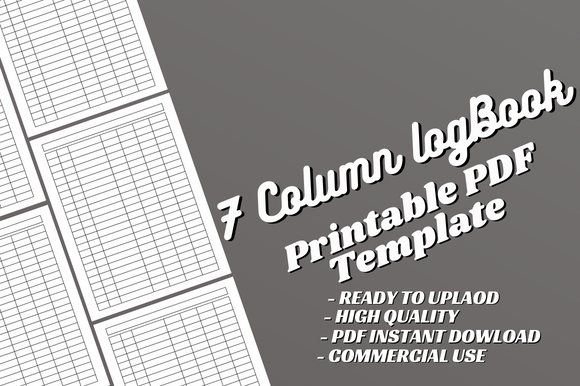
This editable interior template is designed as a foundational tool. It provides a ready-to-use PDF and a fully customizable Canva source file, allowing you to own the structure of your log without starting from a blank page. Its core utility lies in its seven distinct columns, a design that encourages you to categorize information systematically. Whether you’re tracking cash flow, project milestones, inventory, or learning objectives, this framework forces a beneficial discipline: separating data into its logical components.
Where the 7 Column Log Book Integrates Into Your Workflow
Think of the template not as a standalone product, but as a modular component in your larger operational system. Its role is to record. Therefore, its placement in your process is critical. For a small business owner, it might sit between your daily sales receipts and your monthly accounting software, acting as a manual or automated clearinghouse for transaction details. An educator might use it after a lesson plan session to log student progress against specific criteria before entering final grades into a digital platform.
The pre-made 120-page PDF is ready for immediate upload to platforms like Amazon KDP, making it a swift solution for publishers or creators who sell physical log books. However, the real power for most users is the editable Canva file. This is where the template transitions from a fixed product to a living tool. You can alter fonts, adjust column headings, insert your branding, or add instructional text. This adaptability means the same core template can serve a marketing campaign tracker, a hobbyist’s equipment maintenance log, or a novelist’s chapter revision notes.
Preparing and Customizing for Effective Use
Successful implementation begins before you ever write in the first entry. The first practical step is defining what each column will represent for your specific use case. The template provides the structure, but you must provide the semantics. For a cash flow ledger, columns might be: Date, Description, Income Source, Expense Category, Amount In, Amount Out, and Running Balance. For a project management log, they could be: Task Name, Assigned To, Start Date, Due Date, Status, Notes, and Priority.
This act of customization is a planning exercise in itself. It forces you to consider what information is truly essential to track and what relationships between data you need to see at a glance. Using the Canva editor to lock these headings in place creates a consistent format for every page, ensuring that every entry you or your team makes follows the same logic. This consistency is vital for long-term use, as it makes historical data easy to scan and analyze.
Consider also the physical and digital compatibility. The template’s specification—8.5x11 inches, no bleed—means it is optimized for standard US letter printing and seamless upload to print-on-demand services. If your workflow is entirely digital, you can use the customized Canva file to generate digital PDFs for team distribution or personal digital note-taking apps, maintaining the same layout across mediums.
Workflow Examples and Practical Applications
To understand its utility, observe how it functions in real scenarios. A freelance graphic designer, managing multiple clients, might use the 7 Column Log Book as her weekly invoice preparation sheet. Columns for Client, Project, Hours Worked, Rate, Subtotal, Expenses, and Final Amount allow her to aggregate all billing information in one place before generating invoices in her financial software. The log acts as the authoritative source, reducing errors and ensuring nothing is forgotten.
An entrepreneur testing a new product line could employ the template as a market response log. Columns for Date, Customer Feedback Channel (e.g., Instagram, email), Feedback Type (Praise, Critique, Question), Key Quote, Action Taken, Follow-up Date, and Status would transform scattered comments into actionable data. This systematic tracking supports quality control and iterative improvement, directly linking customer interaction to business decisions.
Even for personal goals, such as learning a new language, the structure offers clarity. A learner could track sessions with columns for Date, Study Topic, Duration, Resources Used, Key Insights, Confidence Level, and Next Session Focus. This turns an amorphous learning journey into a documented process, highlighting patterns in effectiveness and keeping motivation aligned with progress.
Interaction with Other Tools and Resources
The 7 Column Log Book KDP interior Template rarely exists in isolation. Its effectiveness is amplified by how it connects to other elements of your workflow. For instance, the data compiled in its columns often feeds into more specialized digital tools. The running balance from a cash flow ledger column can be used to update a quarterly spreadsheet. Task statuses from a project log can be transferred to a team management platform like Asana or Trello.
This interaction underscores the template’s role as a capture tool or a staging area. It’s particularly useful for information that originates in analog forms—meeting notes, handwritten receipts, physical measurements—before being digitized. By providing a standardized entry format, it ensures that this information is organized correctly from the moment it is recorded, saving time and reducing confusion during later transfer.
Furthermore, for KDP publishers, the editable Canva file interacts directly with cover creation tools. The note that you must create your own covers before upload is a reminder that this interior is one half of a product. The workflow here involves finalizing the customized interior, designing a complementary cover in Canva or another program, and then assembling both into the final book ready for Amazon’s platform. The template solves the interior problem efficiently, letting you focus creative effort on the cover and marketing.
Ensuring Long-Term Usability and Efficiency
A log is only as good as the habit of maintaining it. The design of this 7-column format promotes long-term usability through visual clarity and logical grouping. Information is not crammed; it is distributed. This reduces entry fatigue and makes reviewing pages weeks or months later a straightforward task. You can quickly find a specific date, trace a sequence of actions, or calculate a total by scanning aligned columns.
For team or business use, the editable nature supports efficiency and scalability. Once a column logic is decided and the template is customized, it can be distributed to multiple users. Everyone logs data the same way, creating a cohesive dataset. This is crucial for collaborative projects, client management, or any situation where consistency across different contributors is required for accurate aggregation.
Finally, consider the quality control it provides. By committing to a seven-factor breakdown for every significant event or transaction, you institute a mini-review process at the point of entry. You are prompted to consider not just the “what,” but the “when,” “who,” “category,” “value,” “status,” and “next step.” This multifaceted recording often reveals insights or discrepancies immediately, allowing for real-time correction rather than post-hoc discovery of errors.
Integrating the Template Smoothly Into Your Routine
The key to smooth integration is to start simple and let the need evolve. Do not over-customize the Canva file on day one. Begin with a straightforward column definition for a current, pressing need. Use the template for a week. Observe where the process feels frictionless and where you wish for an extra column or a different label. Then, return to the Canva editor and refine. This iterative approach ensures the tool molds to your actual workflow, not your theoretical one.
Place the log, whether physical or digital, at the point in your routine where the relevant activity happens. If it’s for daily sales, keep it with your point-of-sale system. If it’s for creative ideas, have it open during your brainstorming sessions. Physical proximity reduces the chance of skipping entries. For digital use, consider setting the PDF or a screen-share of the Canva design as a pinned tab or desktop shortcut during the relevant work hours.
Remember, the template is a servant to your process, not its master. Its flexibility through Canva is its greatest feature. If a project concludes or a new goal emerges, you can completely redefine the columns and create a new log tailored to that fresh challenge, all from the same source file. This reusability makes it a durable asset, a single solution for myriad tracking needs across professional and personal landscapes.
In essence, the 7 Column Log Book - Canva Template transforms unstructured information into structured records. It bridges the gap between raw data and actionable insight, between individual effort and collaborative consistency. By offering both a ready-to-print product and an editable foundation, it supports immediate use and long-term adaptation, fitting seamlessly into the dynamic workflows of creators, business owners, educators, and anyone who understands that progress is best measured when it is meticulously logged.